
"Toubab" , "Toubabou" or "Toubob" is a Central and West African name for a person of European descent ("whites"). Used most frequently in The Gambia, Senegal, Guinea, and Mali, and also in Ivory Coast - Wikipedia
This is part 2 of my 3-part Senegal story. If you want to read part 1, you can find it here.

After driving from Thiès up to the northern city of Saint-Louis, we quickly checked into our hotel and got some sleep. As always, I planned to wake up early to explore the town and get a sense of what this place is like. I woke up early, a little before sunrise and headed downstairs to the lobby. As I first walked outside, the streets were a little bare. Not many were outside yet, but that would soon change. As the early morning Call to Prayer echoed through the city streets, I finally had a chance to see this town somewhat in the daylight. The first thing I noticed is that the hotel we were staying in was surrounded by many old colorful buildings. In fact, the hotel itself was part of the old postal route that came from France. This was the final stop along that route before mail would be flown across the Atlantic into South America. As a result, this area has always been very developed, and it even served as the capital of Senegal until they decided to switch the capital to Dakar. I walked a few blocks before deciding to wait for the sun to fully rise before exploring more of this place.

The old town where we were staying is located on N’Dar Island, an island in the middle of the Senegal River. This is the most touristy part of Saint-Louis. If you cross the Faidherbe Bridge, you arrive in mainland Saint-Louis, which is where most people live and the part that feels more like an actual city. Then if you cross over the Pont Moustapha Malick Gaye Bridge or Pont Ousmane Masseck Ndiaye Bridge farther down, you reach a narrow strip of sand separating the Senegal River from the Atlantic Ocean, which is known as Langue de Barbarie. This area is known more as a fishing village. The vibe in each of these three regions is very different from the others. As soon as the sun came up, I was determined to go see the beach. One of our teammates and I decided to walk to the other end of N’Dar Island and cross the bridge to Langue de Barbarie to check it out. I quickly started to notice that more people were out walking the streets. Vendors would come up to us and try to sell things to us. We would try to shake them off, but they’re very persistent and can’t seem to take a hint. Eventually, if you just keep ignoring them, they’ll eventually back off.

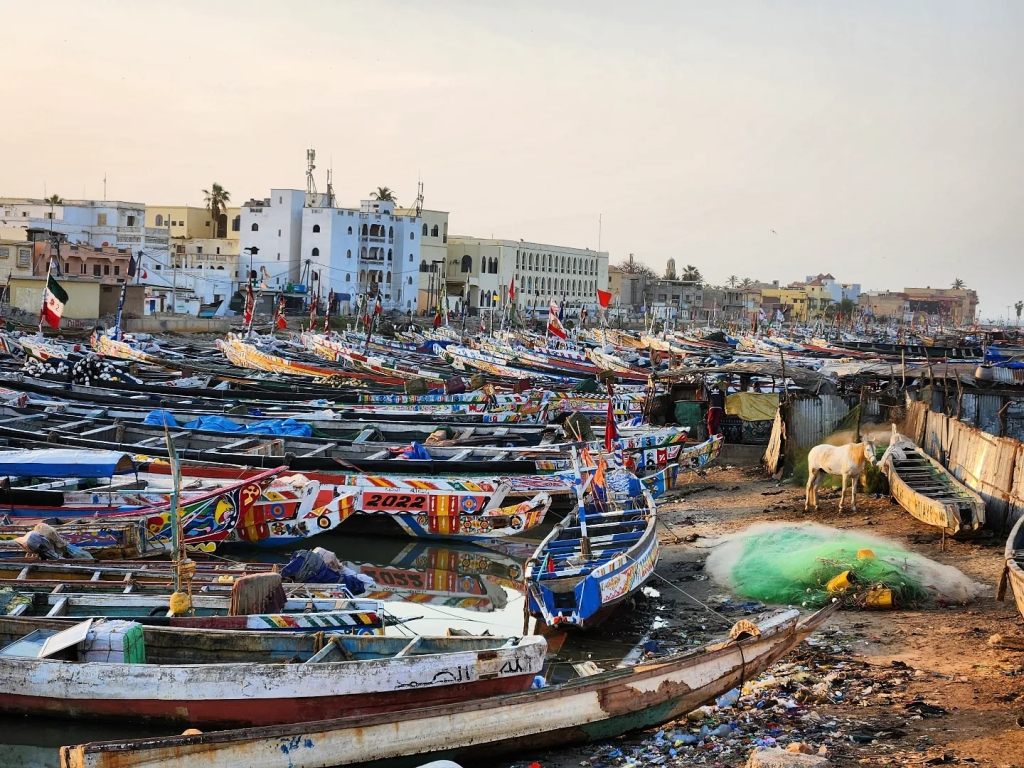
We reached the other end of the island, and the Pont Moustapha Malick Gaye Bridge came into view, along with the other end of the Senegal River, and I was blown away by what I saw. Hundreds of colorful wooden fishing boats were docked along the edge of the river, and they were almost stacked on top of each other because it was so crowded. Some had giant flags waving in the wind. And each boat was uniquely hand painted by its owner: not one was like the other. The bridge passes right through the middle of the boats, and it’s a very uneven bridge to walk across. Half of it is roped off: I’m assuming for repair work. But everyone using the bridge has to crowd into the other half, almost as if both lanes of traffic were stuck trying to use the same lane to get by. And that bridge was crowded! There’s no way to get through without bumping into others. There is a step up along the side with better views of the boats, so that’s what I preferred to use. But the planks on this upper section were more uneven, so I had to watch my step.

After making it across the bridge, we walked into the market area of this fishing village. Thinking back, I actually don’t remember seeing anyone selling fish, but there were many small businesses selling different things along the side of the street. One thing that was impossible not to notice is that this side of the city is overrun by goats. Goats are everywhere, just walking the streets, almost like you’d expect dogs to be in other parts of the world. Don’t get me wrong- there are plenty of stray dogs here too, but the wandering goats seemed to far outnumber them! We continued to walk until we could finally see the entrance to the beach in the distance. I was excited because the small stretch of beach that I drove an ATV to the day before was beautiful- I couldn’t wait to see this one. But as I started to walk out onto the beach, that excitement quickly faded. What I saw was basically a landfill.

This beautiful tropical beach right on the Atlantic Ocean was covered in a layer of trash. As I walked down to the water, I had to pay attention to where I stepped as there were dirty diapers, rotting food, and all the plastic trash you could imagine spread out along the sand. The smell was bad too, as you could probably guess. I watched as one man was practicing his soccer skills on the beach, running in the midst of all the trash. A few of those colorful fishing boats dotted the horizon, but they’re sitting in a literal sea of garbage. I watched as dogs, cats, goats, and birds would scan the coast for old rotting food and often settle for eating straight plastic. Then what really upset me was when I watched a man in the distance walk out onto the beach with a bucket full of trash and just dump it right by the water. This place has the potential to become a tropical paradise, but that is ruined by the lack of care by the locals that use this beach as their personal dumping grounds.

We walked back to the hotel, a little disappointed with the beach experience. But don’t get me wrong: I loved everything else I saw in this city. When we rejoined the group, we got some breakfast and prepared to go to church. (And I felt like I needed another shower after walking on the trash beach). We all crowded onto this local bus. A few lucky people were able to sit down while everyone else had to stand, crowded in there like sardines. We then drove over the Faidherbe Bridge to mainland Saint-Louis. Once we finally arrived at the church’s location, we all jumped out and started walking into an alley. This alleyway would become a very familiar location throughout the rest of the week as it would become the waiting area for our clinic. Each of the buildings is narrow, but they’re all built up. There are three floors in each, with the top floor being the roof. The church building itself is no different: the second floor is where the missionaries live, while the third floor (roof) is a kid’s play area and meeting room.
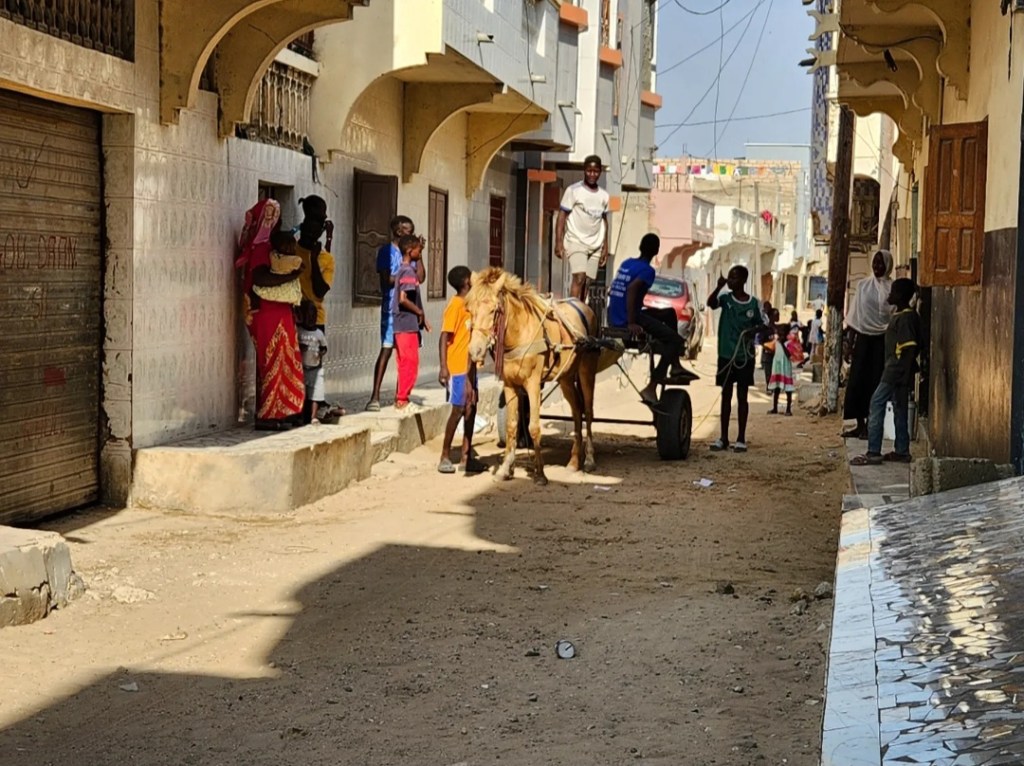
We made some plans for our clinics as we tried to figure out the layout of this site. And soon, church members started showing up. There are a few unique things to point out about this church as it’s located in a Muslim community. First of all, they don’t actually call it a church. This building is referred to as the “center.” There are a couple reasons for this. One reason is that we all know that the church is the people, not the building. But another reason is that churches don’t have any influence or respect in an Islamic culture. If you invite someone to a church, they’ll never come. But by referring to it as a center, it seems to get a different response. Second, they don’t call themselves “Christians” here. In this culture, your name has a lot more significance than it does in Western cultures. If you were given the name “Muhammad” when you were born, you call yourself a Muslim because that’s your name. It’s literally your identity and how you view yourself. But if your name is “John” then you’re called a “Christian” regardless of your religious beliefs: it’s all in your name. So in order to not confuse others, they don’t use the term “Christian” but rather call themselves “disciples of Christ.”

One last thing to point out about this church is that many of the church’s followers never actually come in person. They have an online ministry that they use to reach hundreds of Wolof speakers all over Senegal. When Covid hit and in-person services stopped for a while, they worried that this would be the end of the church. But when they started broadcasting services online, it actually ended up spreading the church’s influence much broader than they had ever expected! No one ever hears the gospel preached in Wolof, so this new message really caught many people’s attention. In this culture, those who convert to Christianity are often shunned by their family, but this online ministry now allows for them to watch in secret without their family knowing. Many write in to let the pastor and church know that they are following along but can’t let their family know. While Covid seemed to have no positive side to it, we forget about communities like this where it actually allowed for the church to grow undetected in a region where Islam has such a strong hold over the people.

The church service started, and I always love attending church services in other countries. I tried to sing along to the Wolof worship songs, but it’s easier said than done. People kept trickling in throughout the service, and we had to keep making more room for them as they showed up. Pastor Malick, the church’s local pastor, gave a great message, and before we knew it, the service was over. It was then time to count pills and prepare for our upcoming clinics. We determined that this “center” wasn’t big enough for our full clinic, so we had to make some different arrangements. Fortunately, the neighbor across the street allowed us to use their building for dental and optical, with optical being on the roof overlooking the city. Just a few doors down was the local mosque with its minaret rising high above every other building within sight. I watched as kids ran around the alley below, literally living in the shadow of a mosque. It’s so evident that this community desperately needs to hear about Jesus, and I was excited to get to work with this incredible ministry to reach them with the gospel.

We went back to N’Dar Island later that day and all gathered for dinner at a nearby restaurant where we got to know the missionaries and each other a little more. Then some of us decided to try to do some souvenir shopping, but of course, we were all crowded with local vendors trying to sell stuff to us. They would literally feel like magnets that you can’t get rid of as they would yell out “Hello, my friend! I’ve got some nice soccer jerseys for you!” [As they’re literally shoving the soccer jersey in your face] “I give you good price! All your friends are buying it!” It doesn’t matter how many times you explain that you’re not interested, they don’t leave. When you actually get inside someone’s store, it’s much calmer. Some vendors would try to rip us off, and I refused to buy anything from them, no matter how much I liked what they were selling. Then I would find one that offered decent prices. But after leaving the store, you’re back to getting mobbed with “Hello, my friend! I’ve got some [insert random object] for you! I offer you good price!” We all eventually got used to it by the end of the week, but it’s a little overwhelming at first.

After a night of getting crowded by local vendors and trying to not get ripped off in their stores, we headed back to the hotel, eagerly awaiting the start of our clinic the next morning. Make sure to check back later this week as I share the final part of this story and take you into our clinics. Thanks for reading!

 Tyler's Travels